Product quality plays an important role in maintaining customer trust and meeting industry standards. Whether a product is used in food production, pharmaceuticals, or other industries, it must meet the required quality and safety standards before reaching customers. Even a small error during testing can affect product performance, safety, and consistency.
This is where advanced laboratory equipment becomes important. Modern laboratory testing equipment helps professionals examine samples, measure different properties, identify unwanted substances, and check whether products meet established specifications. These instruments improve measurement accuracy, reduce manual effort, and help laboratories perform testing procedures more efficiently.
From measuring the weight of a sample to detecting trace elements, different laboratory equipments perform specific tasks. Understanding their functions helps explain how advanced equipment supports reliable quality testing, product consistency, and better decision-making.
Why Is Quality Testing Important?
Quality testing helps manufacturers check whether raw materials, production processes, and finished products meet the required standards. During manufacturing, variations in ingredients, processing conditions, or storage can affect the final product. Regular testing helps identify these differences before they become larger problems.
Laboratory testing also provides useful information that businesses can use to improve their production processes and maintain consistent quality.
Some important purposes of quality testing include:
- Checking raw materials before production.
- Identifying impurities and unwanted substances.
- Measuring the composition and properties of samples.
- Maintaining consistency between production batches.
- Supporting product safety and regulatory compliance.
- Reducing the risk of errors and product rejection.
With suitable laboratory equipments, businesses can make informed decisions based on test results rather than assumptions.
How Does Advanced Laboratory Equipment Help Improve Quality Testing?
Different laboratory instruments support different stages of the testing process. Some analyse chemical composition, while others prepare samples, measure materials, or maintain suitable conditions for laboratory work.
Let’s understand how these instruments contribute to quality control.
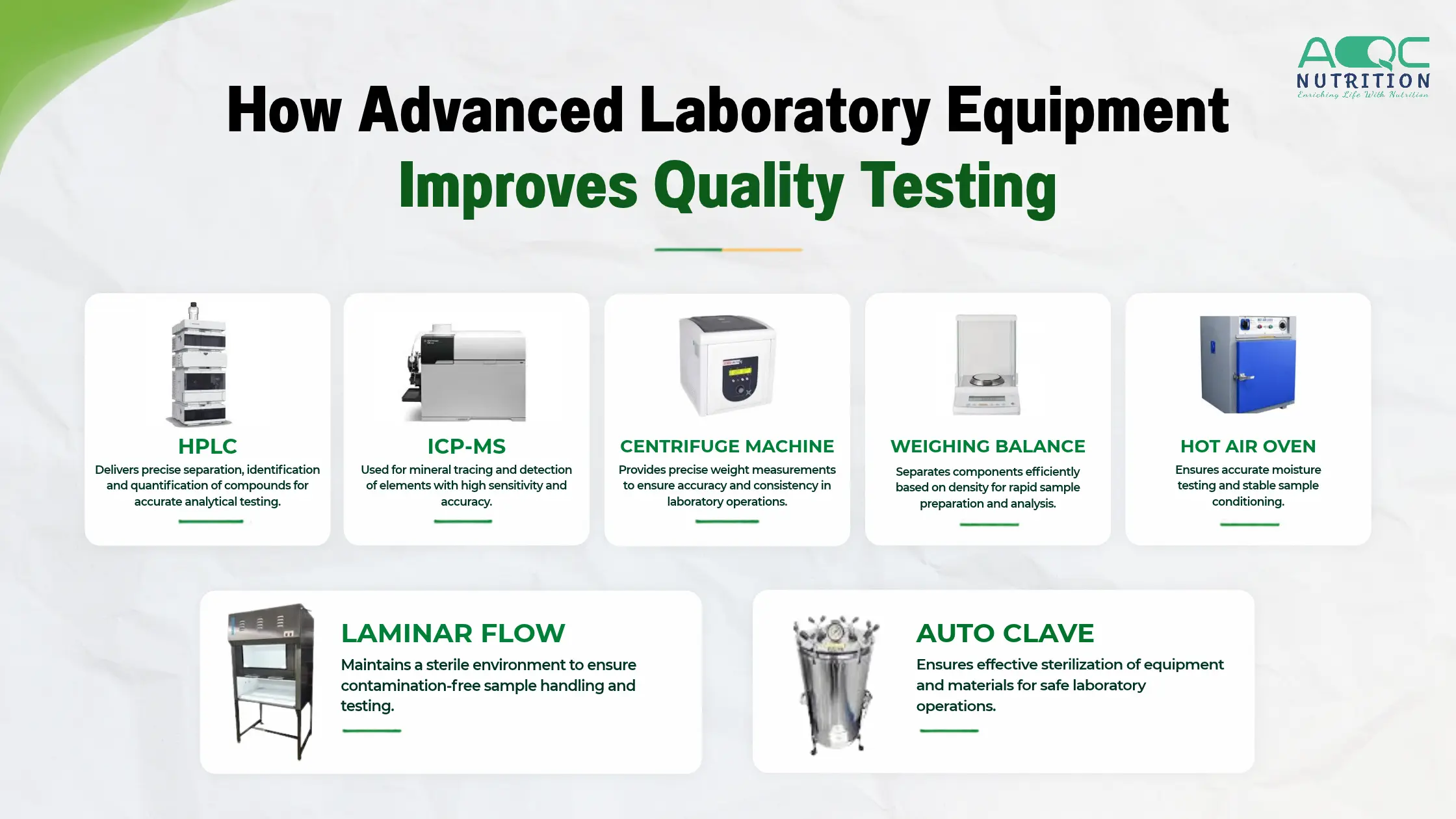
1. HPLC for Accurate Analysis
High-Performance Liquid Chromatography (HPLC) is an analytical technique used to separate, identify, and measure compounds present in a liquid sample. It is widely used in pharmaceutical testing, food analysis, and other applications that require detailed analysis.
HPLC helps laboratory professionals determine whether specific compounds are present in the expected quantities. It can also help identify impurities and variations in sample composition.
For example, laboratories may use HPLC to measure selected vitamins, preservatives, and other chemical compounds in food or pharmaceutical products, depending on the validated testing method.
The detailed results help professionals assess product composition, investigate quality variations, and check whether a sample meets the required specifications. This makes HPLC an important tool for accurate analysis and quality control.
2. ICP-MS for Trace Element Detection
Inductively Coupled Plasma Mass Spectrometry (ICP-MS) is used to detect and measure elements at very low concentrations. It is particularly useful when laboratories need detailed information about minerals, trace elements, and certain potentially harmful metals.
This analytical instrument is used in food safety testing, pharmaceutical analysis, environmental testing, and mineral analysis. Its high sensitivity allows laboratories to detect elements that may be difficult to measure using less sensitive techniques.
For example, ICP-MS can help determine the concentration of selected trace metals in raw materials or finished products. These results support contamination assessment and help laboratories evaluate whether samples meet applicable safety requirements.
By providing detailed information about elemental composition, ICP-MS supports reliable testing and better quality-related decisions.
3. Centrifuge Machine for Efficient Sample Preparation
Proper sample preparation is an important part of laboratory testing. A centrifuge machine separates components of a sample by spinning it at high speed. The resulting centrifugal force helps separate components according to their physical properties, including density.
Depending on the sample, a centrifuge may be used to separate suspended particles from liquids or prepare specific components for further analysis.
For example, a laboratory may centrifuge a sample before performing another analytical test. This helps prepare the material according to the requirements of the selected method.
A suitable centrifuge improves sample-handling efficiency and supports a more organised testing workflow. However, the correct centrifugation conditions depend on the sample type and the purpose of the test.
4. Weighing Balance for Precise Measurements
Accurate weighing is essential for many laboratory procedures. A laboratory weighing balance measures the mass of samples, chemicals, and other materials used during testing.
Even a small measurement error can affect the concentration of a solution or the outcome of an experiment. Analytical and precision balances help laboratory professionals measure materials accurately when the instrument is selected according to the required measurement range.
For reliable results, the balance should be placed on a stable surface, handled correctly, and calibrated at appropriate intervals. Environmental conditions, including vibration and air movement, should also be considered when taking sensitive measurements.
Accurate weighing helps laboratories follow standard procedures, maintain consistency, and reduce avoidable measurement errors.
5. Hot Air Oven for Moisture Testing and Sample Conditioning
A hot air oven uses controlled dry heat to dry or heat samples and laboratory materials. It is used for applications such as sample conditioning, drying, and procedures that require a controlled temperature.
In certain moisture determination methods, a sample is weighed before and after drying. The difference in weight is then used to calculate moisture content according to the specified testing procedure.
Moisture testing is important because moisture levels can affect product stability, storage life, texture, and processing performance. This is particularly relevant for food ingredients, grain-based products, and other raw materials.
The correct drying temperature and duration depend on the material and the testing method. Following these conditions helps laboratories obtain consistent and meaningful results.
6. Laminar Flow Cabinet for Clean Sample Handling
Keeping samples free from unwanted contamination is important for reliable laboratory testing. A laminar flow cabinet provides a controlled airflow environment designed to reduce airborne particle contamination in the work area.
It is commonly used for procedures that require clean sample handling. By reducing exposure to airborne particles, suitable laminar flow equipment helps maintain sample integrity during preparation and handling.
However, equipment selection is important. A standard laminar flow cabinet does not necessarily protect laboratory personnel from hazardous chemicals or infectious materials. Laboratories should choose suitable containment equipment according to the risks associated with each procedure.
Maintaining the equipment properly and following established laboratory practices further supports clean and controlled working conditions.
7. Autoclave for Laboratory Sterilisation
An autoclave uses pressurised steam at a controlled temperature to sterilise compatible laboratory equipment and materials. It helps destroy microorganisms that could otherwise contaminate samples or interfere with laboratory procedures.
Sterilisation is especially important in microbiology laboratories and other applications where microbial contamination can affect test results.
The effectiveness of an autoclave depends on several factors, including temperature, exposure time, loading conditions, and the type of material being processed. Laboratory staff must follow the appropriate sterilisation cycle and equipment instructions.
By supporting effective sterilisation, an autoclave helps laboratories maintain suitable working conditions and reduce the risk of contamination.
How Do These Equipments Work Together?
Reliable quality testing often involves several stages, and different laboratory equipments may be required at each stage.
For example, a weighing balance may be used to measure a sample before it undergoes preparation using a centrifuge. Depending on the testing objective, the prepared sample may then be analysed using HPLC or ICP-MS. A hot air oven may be used for a separate moisture determination, while suitable clean-handling and sterilisation equipment supports procedures that require contamination control.
Not every sample requires all these instruments. Equipment selection depends on the sample type, testing objectives, required accuracy, and applicable standards.
For vitamin and mineral premix manufacturers, appropriate testing procedures help assess raw materials and finished products against defined specifications. Accurate ingredient measurement, suitable analytical methods, and controlled production processes all contribute to product consistency.
Best Practices for Reliable Laboratory Results
Advanced laboratory equipment can improve testing, but reliable results also depend on how the instruments are selected, operated, and maintained.
Laboratories should follow these practices:
- Regular calibration: Check that measuring instruments provide results within the required accuracy limits.
- Proper maintenance: Inspect and maintain equipment according to the manufacturer’s instructions.
- Validated testing methods: Use appropriate procedures for the sample and the intended analysis.
- Trained personnel: Ensure that laboratory staff understand correct instrument operation and safety requirements.
- Proper documentation: Record testing conditions, results, and relevant observations for future reference and quality audits.
- Suitable equipment selection: Choose instruments according to the sample type, required detection limits, and testing purpose.
These practices help reduce avoidable errors and improve confidence in laboratory results. For premix manufacturers, they also support consistent assessment of ingredients and finished products.
Conclusion
Advanced laboratory equipment plays an important role in accurate testing, sample preparation, and quality control. Instruments such as HPLC, ICP-MS, weighing balances, hot air ovens, and other specialised tools help laboratory professionals analyse samples and evaluate different product properties.
For vitamin and mineral premixes, accurate ingredient measurement, proper blending, and regular quality checks are important for maintaining product consistency. At AQC Chem Lab, quality assessment is relevant to the development of micronutrient premixes and food fortification solutions designed for specific nutritional and formulation requirements.
By combining suitable laboratory equipment with appropriate testing methods and quality control practices, manufacturers can identify variations, maintain consistent product standards, and make informed decisions. These practices help support reliable premix solutions for different food fortification applications.
For more details, visit our website: www.aqcchem.com or contact us at +91-99207 79504.