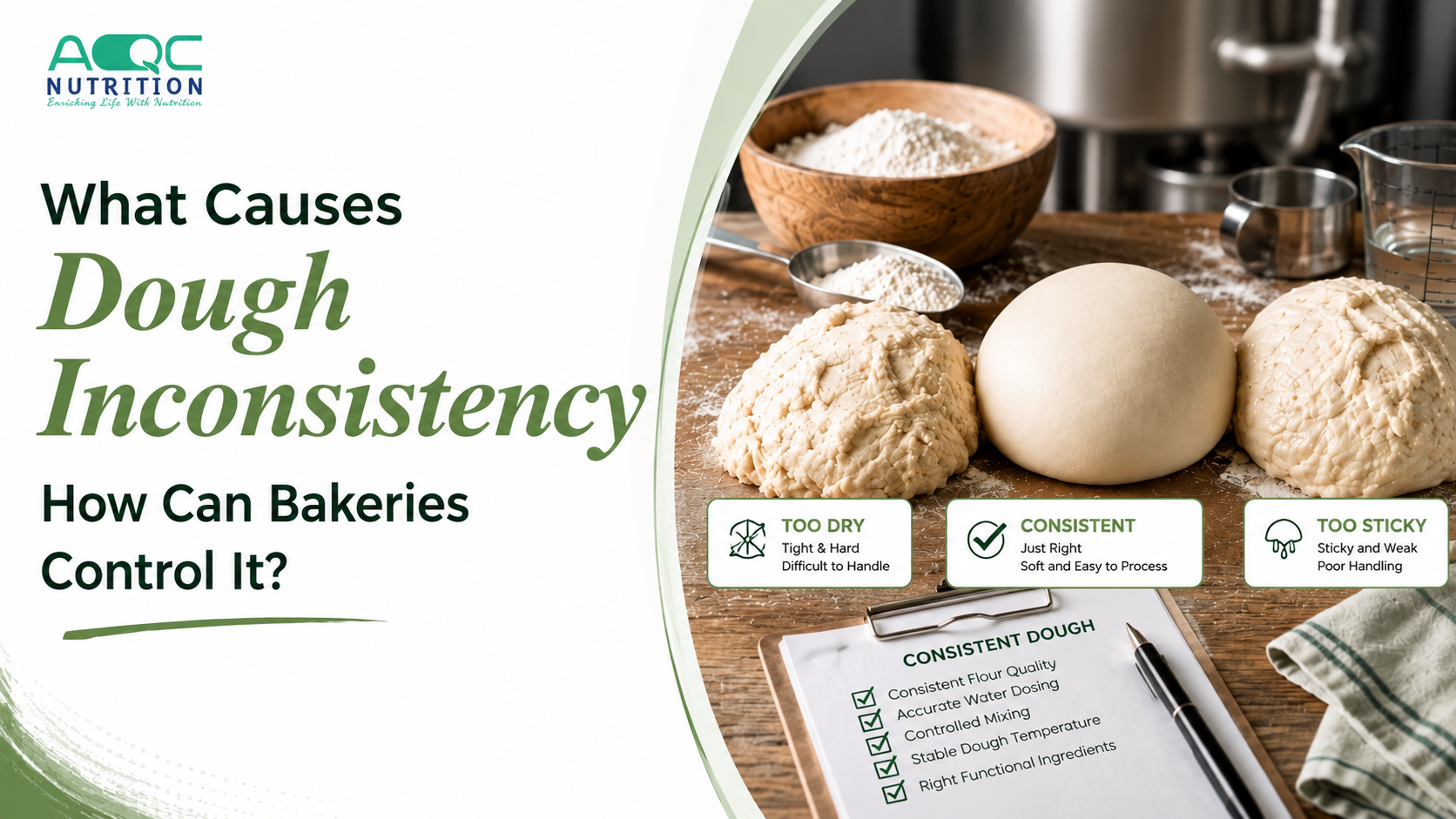
A dough may look simple, but its behaviour can change significantly from one batch to another. One batch feels soft and easy to handle, while the next feels sticky, tight, or difficult to process.
This is a common challenge in commercial baking. Even small changes in flour quality, water absorption, mixing, temperature, or functional ingredients can affect dough consistency and ultimately change the quality of the finished product.
For bakeries, controlling these variations is important not only for product quality but also for smooth production and consistent results.
So, what causes dough inconsistency, and how can bakeries control it?
What Is Dough Consistency?
Dough consistency refers to how dough behaves during mixing, fermentation, handling, and processing.
Depending on the bakery product, consistent dough may need the right balance of:
- Dough strength
- Elasticity
- Extensibility
- Water absorption
- Softness
- Processing tolerance
When these properties change from batch to batch, the dough may become too sticky, too dry, too soft, or too tight. It may also respond differently during fermentation, dividing, shaping, and baking.
That is why consistent dough quality is an important part of reliable bakery production.
What Are the Signs of Inconsistent Dough?
Dough inconsistency can often be noticed during production. Some common signs include:
- Dough becoming unusually sticky or dry
- Changes in dough strength or elasticity
- Difficulty during mixing or machine handling
- Different fermentation behaviour between batches
- Variation in dough volume
- Problems during dividing or shaping
- Changes in final product volume and texture
- Differences in crumb structure or appearance
Identifying these signs early can help production teams find the underlying cause before it affects a larger batch.
What Causes Dough Inconsistency?
Usually there are more than one causes for dough that is not consistent. Dough behaviour can vary due to flour characteristics, water, mixing, temperature, ingredients and processing conditions.
1. Variation in Flour Quality
Wheat Flour is one of the important and biggest factors that affect dough performance.
The protein content, moisture content, quality of gluten, and water absorption can change the batch to batch flour. Even when flour appears the same, these differences can change how the flour reacts during mixing and fermentation.
For example, variation in gluten quality can impact on the dough strength and elasticity, and a change in the moisture content of flour can impact the water absorption.
Maintaining clear flour specifications and regularly checking important quality parameters can help reduce batch-to-batch variation.
2. Changes in Water Absorption
Water looks like a simple ingredient, but it can have a big impact on the dough consistency.
The amount of water required can change depending on the characteristics of the flour. When the flour absorbs more water than predicted, the dough may become too hard. If it absorbs less, the dough may be softer or stickier.
Accurate water dosing, along with regular monitoring of flour absorption, can help maintain the desired dough texture.
3. Protein and Gluten Quality
Protein content is important, but it does not tell the complete story.
Gluten quality and functionality affects dough strength, extensibility, elasticity and gas holding capacity. This means that two flours containing the same amount of protein might react differently in processing.
This is particularly important for bakery products that need to be given a particular dough strength or volume.
Knowing both the quantity and gluten properties of the protein can assist in choosing the appropriate flour for a specific application in bakeries.
4. Mixing Conditions
Mixing is the process that influences the degree of incorporation of ingredients and the development of the gluten network.
The time spent in mixing the dough too short or too long can have a negative effect on the dough properties. The dough can be influenced by type, speed, and time of mixing and by the temperature of the dough.
Bakeries do not have to use only a fixed mixing time, but can be able to measure the dough development and set up the proper mixing conditions for their dough formulation and mixing equipment.
5. Dough Temperature
Temperature can have a direct effect on dough behaviour.
The dough temperature can be affected by the water, flour, ingredients and the environment temperature. This can impact fermentation, dough development and handling.
If one batch is fermented at a different temperature to any other, its behaviour will also change.
This type of variation can be minimized by frequent tests of dough temperature and by careful control of processing conditions.
6. Dough Softeners and Functional Ingredients
Functional ingredients can play an important role in achieving the desired dough and finished-product characteristics. In bakery applications, dough softeners are frequently used to improve softness, texture, volume and quality of the dough.
The effect of dough softeners is influenced by the characteristics of the flour, recipe composition, processing conditions, dosage, and type of bakery product.
It is important to use the correct formulation for the appropriate use and not the same one for all products.
How Does Dough Inconsistency Affect Bakery Production?
When dough does not perform consistently, the problem can continue throughout the production line.
Variation in dough properties may result in:
| Dough Problem | Possible Production Impact |
| Too sticky | Difficult handling and machine processing |
| Too firm | Poor machinability and shaping issues |
| Low dough strength | Reduced structure and volume |
| Excessive elasticity | Difficulty in sheeting or shaping |
| Poor extensibility | Processing and forming problems |
| Uneven fermentation | Variation in product size and quality |
For commercial bakeries, controlling these variations can help improve both product consistency and production efficiency.
How Can Bakeries Improve Dough Consistency?
Improving dough consistency starts with understanding where variation is coming from.
A practical approach is to monitor the major factors that influence dough behaviour:
| Factor | What to Monitor |
| Flour | Protein, moisture, gluten quality, water absorption |
| Water | Quantity and dosing accuracy |
| Mixing | Time, speed, and dough development |
| Temperature | Ingredient and final dough temperature |
| Ingredients | Type, quality, and dosage |
| Fermentation | Time and processing conditions |
| Dough performance | Strength, elasticity, extensibility, and handling |
Regular testing and process monitoring can help identify changes before they become larger production issues.
Can Dough Softeners Help Improve Dough Consistency?
Dough softeners can play an important role in improving the handling and overall quality of dough. They are used in bakery formulations to help achieve desirable characteristics such as softer texture, improved dough handling, better volume, and more consistent finished products.
However, the requirement for a dough softener can vary depending on the flour, recipe, processing conditions, and type of bakery product. The right formulation should therefore be selected according to the specific production requirement.
For bakeries facing challenges such as inconsistent dough texture, poor softness, or variation in finished-product quality, a suitable dough softener can help improve the desired characteristics and support more consistent production.
How AQC Chem Supports Bakery Applications
Developed to meet specific product and processing requirements, AQC Chem provides dough softeners and flour improvers for bakery applications. Depending on the formulation, these solutions can be used for improving the characteristics like dough handling, softness, texture, volume, moisture retention or product uniformity.
Because every bakery works with different flour, recipes, equipment, and processing conditions, the right formulation may vary from one application to another. AQC Chem can help manufacturers select the right ingredient solutions based on their specific production requirements.
Final Thoughts
Several factors contribute to the consistency of the dough from water absorption to mixing, dough temperature and selection of ingredients.
These factors can be easier for bakery staff to determine the cause of dough changes and ensure more consistent production if they know about them.
If ingredient support is required, the appropriate selection of dough softeners, flour improvers, enzymes and other functional ingredients can be chosen for the specific bakery application.
Using the correct formulation and process control will help the manufacturer work toward improved dough handling, dough consistency, dough volume and finished product quality.
Need Better Dough Consistency?
The right dough softener or flour improver can help improve dough handling, softness, and product uniformity. Connect with AQC Chem to find the right ingredient solution for your bakery application. Visit aqcchem.com or call +91 9920779504 to discuss your requirements.