It isn’t always easy to get all the essential vitamins and minerals that your body needs every day. Nutrient intake may be affected by eating habits and food choices, food price availability and affordability, and access to different types of food.
Therefore, food fortification is now an important part of modern nutrition strategies.
One such example is edible oil. It’s already used every day at home and in the food industry for cooking, frying, baking and preparing food. In the process of fortification, adding essential micronutrients to a food that is already consumed by people can help improve nutrient intake without requiring major changes to their everyday dietary habits.
But adding nutrients to oil is not as simple as mixing them together. It is important that the nutrients be carefully selected, added at the proper level, placed uniformly, and remain stable during processing, storage, and use.
So, how does oil fortification work, what benefits can it offer, and what should manufacturers consider when developing fortified edible oil?
Let’s find out more.
What Is Oil Fortification?
Oil fortification is the process of adding selected vitamins or other suitable nutrients to edible oil in controlled amounts for improving its nutritional value.
The process starts by selecting nutrients that are suitable for the intended nutritional purpose and compatible with the oil. Important nutrients need to be added in the right amount and mixed properly to ensure they are evenly distributed throughout the product.
Stability is another important part of the process. Nutrient quality may change with time due to the action of heat, light, oxygen, storage conditions, and packaging.
This means successful oil fortification is not only about adding nutrients. It is about making sure those nutrients remain stable and available at the desired level throughout the product reaches the consumer.
It is also important to remember that fortified oil is not a replacement for a balanced diet. It is an additional nutritional strategy that can help improve the consumption of specific nutrients.
Why Is Edible Oil Useful for Fortification?
One of the biggest advantages of edible oil is that it is being used on a routine basis.
Many households use oil in their cooking and it is also common in food production, restaurants and food businesses. People already know how to use it, so a fortified product can fit naturally into their existing food habits.
Some fat-soluble vitamins (those that are not soluble in water) can also be included in edible oil. This makes oil as a suitable food medium for some fortification purposes.
But not all nutrients are suitable for all the oil types. Nutrient selection depends on factors such as the oil, required nutrient level, processing conditions, stability, and applicable regulations.
This is why oil fortification needs to be planned around both nutritional needs and technical requirements.
How Does Fortified Oil Support Everyday Nutrition?
Fortified oil can help increase the intake of selected micronutrients as part of a broader nutrition strategy.
Its biggest practical advantage is convenience. Consumers can continue using oil in the same way they normally do while receiving additional amounts of the nutrients added to the product.
The actual nutritional contribution can depend on several factors, including:
- The type of nutrient added
- Fortification level
- Amount of oil consumed
- Nutrient stability during storage
- Nutrient retention during cooking
- Consistency of the fortification process
So, the objective is not simply to add a nutrient to oil. The objective is to deliver that nutrient consistently and appropriately in the finished product through a well-controlled oil fortification process.
What Are the Benefits of Fortified Edible Oil?
When properly formulated and manufactured, fortified edible oil can offer several practical benefits.
- Convenient Nutrient Delivery: Fortified oil can provide selected nutrients through a food people already consume regularly.
- No Major Change in Cooking Habits: Consumers can use fortified oil in their usual cooking without changing their regular food habits.
- Supports Micronutrient Intake: Fortification can help increase the intake of selected vitamins and nutrients when added at appropriate levels.
- Useful for Wider Nutrition Programs: Edible oil can support large-scale fortification programs where it is suitable for the target population and regulations.
- Supports Consistent Food Manufacturing: A well-designed system helps manufacturers control nutrient addition through accurate dosing, mixing, testing, and process monitoring.
These benefits depend on proper formulation, manufacturing controls, product quality, and compliance with applicable standards.
These benefits depend on proper formulation, manufacturing controls, product quality, and compliance with applicable standards.
Which Vitamins Are Commonly Added to Edible Oil?
The nutrients used for oil fortification depend on nutritional requirements, public health objectives, regulations, and the characteristics of the edible oil.
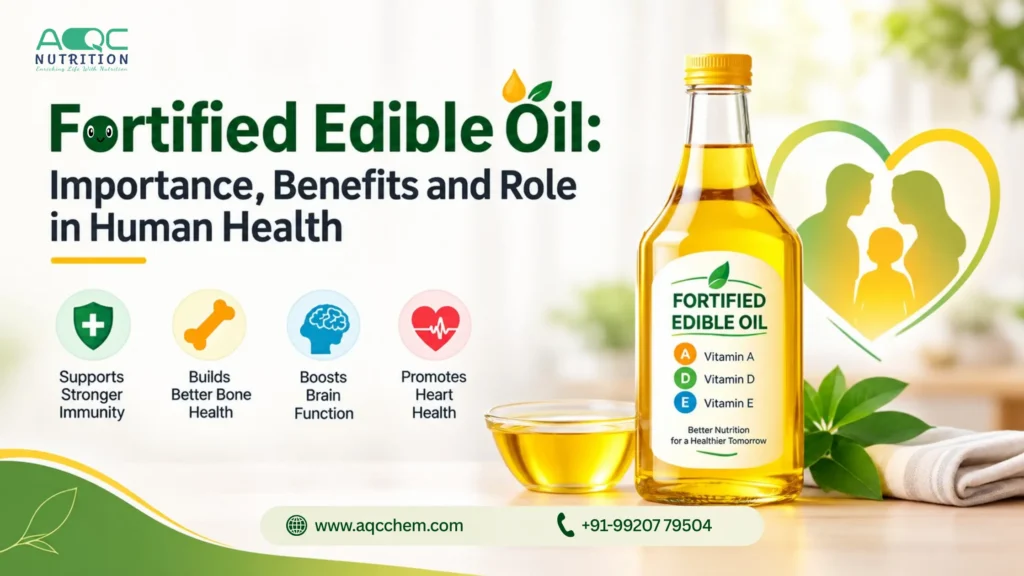
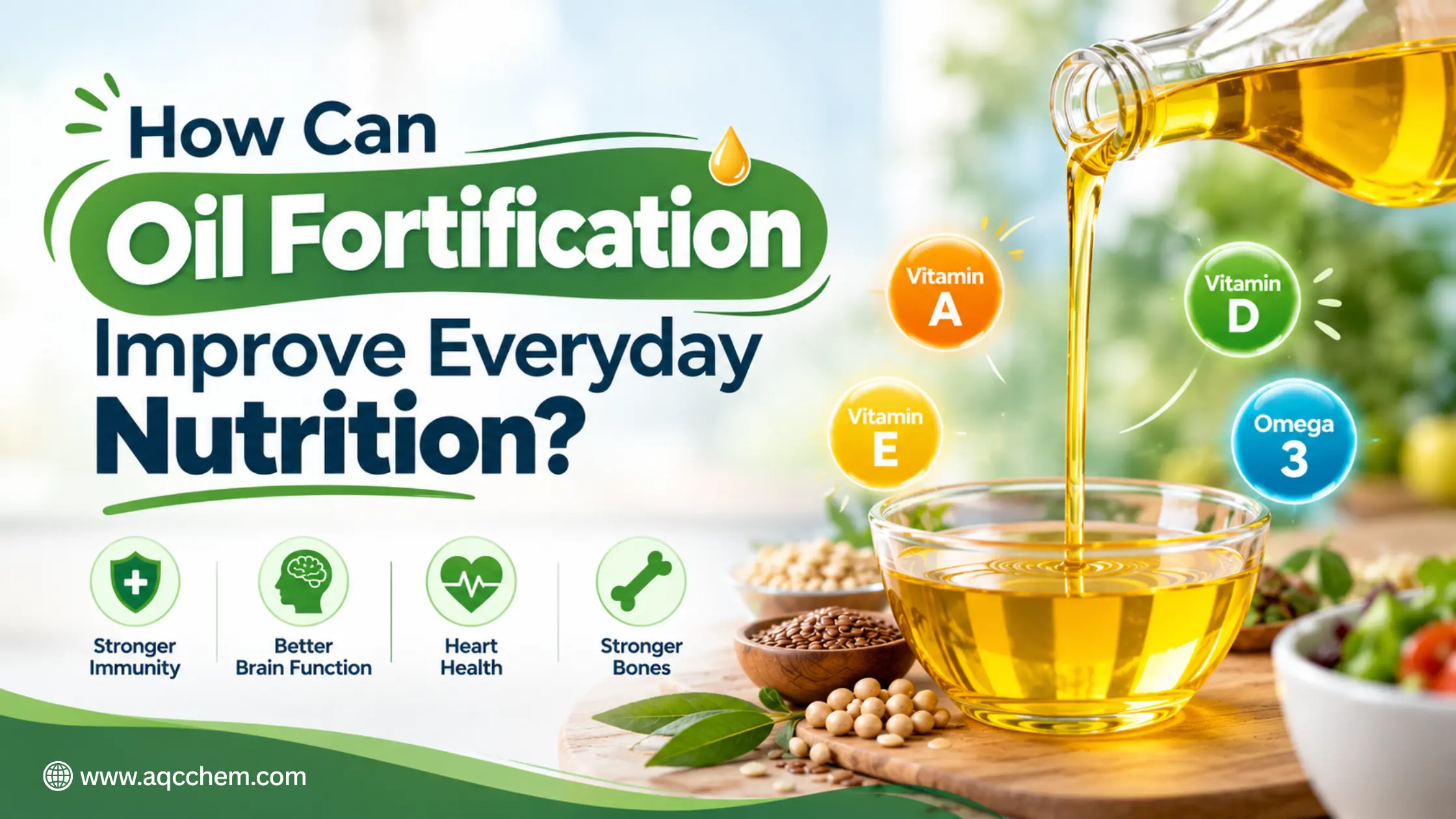
Vitamin A is commonly associated with edible oil fortification. It is an essential nutrient that supports normal vision, immune function, and other important body functions.
Vitamin D may also be used in certain fortified food applications. It plays a role in calcium absorption and maintaining normal bone health.
Vitamin E is another fat-soluble vitamin that may be considered in fortified oil applications. It acts as an antioxidant and helps protect cells from oxidative stress.
Omega-3 fatty acids can also be added to selected oil products to increase their nutritional value. However, their use requires attention to formulation, processing conditions, storage, and oxidation stability because these fatty acids can be sensitive to oxidation.
Since edible oil is a fat-based food, it can be particularly suitable for selected fat-soluble vitamins and other oil-compatible nutrients. However, the right nutrient, form, and fortification level need to be determined according to the intended application and relevant requirements.
The goal is not to add as many nutrients as possible. Good oil fortification focuses on choosing the right nutrient, in the right form, at the right level.
Can Oil Fortification Help Address Micronutrient Deficiency?
Micronutrient deficiency can occur when the diet does not provide enough of certain essential vitamins or minerals over time. Addressing such deficiencies usually requires more than one approach.
A balanced and varied diet remains important, while supplementation and food fortification may also have a role depending on the specific nutritional need and target population.
Fortified oil can be one part of this broader approach.
Its advantage is that it can deliver selected nutrients through a familiar food that people may already consume regularly. This can make fortification a practical way to support micronutrient intake.
However, fortified oil should not be considered a complete solution for nutritional deficiencies. Different foods provide different nutrients, so dietary diversity remains an important part of overall nutrition.
The impact of a fortification program can also depend on factors such as product availability, consumption patterns, fortification levels, nutrient stability, quality control, and regulatory compliance.
How Does Cooking Affect Nutrients in Fortified Oil?
A common question for manufacturers is whether the added nutrients remain stable when the fortified oil is used for cooking.
The answer depends on several factors. Nutrient stability can be affected by various factors such as heat, cooking time, oil type, nutrient category and cooking techniques.
For example, longer exposure to high temperatures may affect some sensitive nutrients more than shorter heating periods. Storage conditions before the oil reaches the kitchen can also influence nutrient stability.
This means manufacturers need to consider how the edible oil will actually be used, not only how the product performs during manufacturing.
Testing under expected storage and cooking conditions can help manufacturers understand how well the selected nutrients are retained during normal use.
Why Is Nutrient Stability Important in Oil Fortification?
Adding nutrients to edible oil is only one part of the fortification process. Those nutrients also need to remain stable throughout the product’s shelf life.
Several factors can affect nutrient stability, including:
- Light exposure
- Oxygen exposure
- Heat
- Storage temperature
- Packaging
- Handling
- Processing conditions
- Length of storage
For manufacturers, stability should therefore be considered from the early stages of product development.
The form and quality of the fortificant, its compatibility with the oil, expected shelf life, packaging material, and storage conditions all need to be considered.
Testing can help manufacturers understand how the formulation performs over time and whether the product continues to meet the required specifications.
What Should Manufacturers Consider When Fortifying Edible Oil?
For a food manufacturer, successful fortification involves much more than adding a premix to the production line. Several parts of the process need to work together.
- Nutrient Selection
The first step is choosing nutrients that address the intended nutritional requirement and are suitable for use in the selected oil. - Premix Compatibility
The fortification premix should be suitable for the intended application. Its compatibility with the oil, processing conditions, and required nutrient levels needs to be considered during formulation. - Accurate Dosing
The correct quantity of fortificant needs to be added consistently. Accurate dosing helps maintain the required nutrient concentration from one production batch to another. - Uniform Mixing
The nutrients should be evenly distributed throughout the oil. Proper mixing and process control are important for achieving consistent fortification. - Nutrient Stability
The formulation should account for conditions that may affect nutrient quality, including heat, light, oxygen, storage, and handling. - Quality Testing
Regular testing can help manufacturers monitor nutrient levels, product consistency, and overall quality. It can also help identify variations that may need attention during production. - Packaging and Storage
Packaging plays an important role in protecting sensitive nutrients from factors such as light and oxygen. Suitable storage conditions are equally important for maintaining product quality. - Regulatory Compliance
Fortified edible oil needs to meet the relevant food safety, fortification, quality, and labeling requirements of the target market. These requirements should be considered throughout product development and manufacturing.
What Is the Role of Fortification Premix?
A fortification premix can make controlled nutrient addition more practical for food manufacturers.
Instead of handling individual nutrients separately, a suitable premix can provide selected vitamins or other nutrients in a form designed for controlled addition to the food product.
However, choosing a premix is not only about nutrient content. Manufacturers also need to consider compatibility, dosing accuracy, dispersion, stability, processing conditions, and final product requirements.
A well-planned premix and dosing system can help manufacturers achieve more consistent fortification while making the production process easier to manage.
What Is the Future of Fortified Cooking Oil?
The future of fortified cooking oil will depend not only on adding nutrients but also on making the overall fortification process more accurate, stable, consistent, and manageable.
Food manufacturers are increasingly focusing on better dosing systems, improved formulation, process monitoring, quality testing, and traceability.
At the same time, nutrient stability and product quality will remain important considerations as manufacturers work to maintain nutritional value throughout processing, storage, distribution, and use.
For the food industry, effective fortification is ultimately about bringing several factors together: nutrition, formulation, stability, quality, safety, manufacturing efficiency, and regulatory compliance.
Conclusion
Oil fortification offers a practical way to add selected essential nutrients to a food that is already part of everyday cooking.
Its main advantage is convenience. Consumers can continue using edible oil in familiar ways while receiving additional amounts of selected micronutrients through the fortified product.
For manufacturers, however, achieving consistent fortification requires careful planning. Nutrient selection, premix compatibility, accurate dosing, uniform mixing, nutrient stability, quality testing, packaging, storage, and regulatory requirements all have an important role to play.
When used as part of a broader nutrition strategy and a balanced diet, fortified edible oil can contribute to improving nutrient intake while fitting naturally into everyday food consumption.
Looking for the Right Fortification Solution for Edible Oil?
Looking for the right oil fortification premix for your product? AQC Chem provides customized nutrition and fortification solutions designed to meet specific formulation, stability, and dosing requirements. Talk to our experts today: +91-99207 79504
and visit our website www.aqcchem.com to learn more.